Insight

Industry insights and case studies

What China's Dual AI Filings Actually Mean for Brands Evaluating a GEO Vendor

For multinational brands evaluating GEO vendors in China, the useful compliance question is concrete: does the vendor hold an Algorithm Filing, a Generative AI Service Filing, or both?

Two filings, one question

If you're a multinational brand looking at GEO vendors in China, you've probably been told by more than one of them that they're "fully compliant." That phrase does almost no work on its own. The question worth asking instead is narrower and more concrete: does this vendor hold an Algorithm Filing, a Generative AI Service Filing, or both — issued by China's Cyberspace Administration (CAC)?

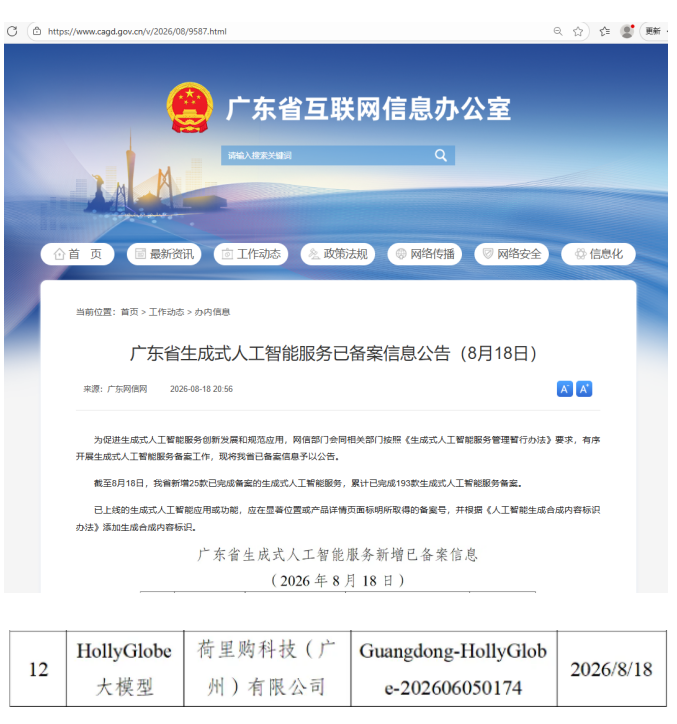
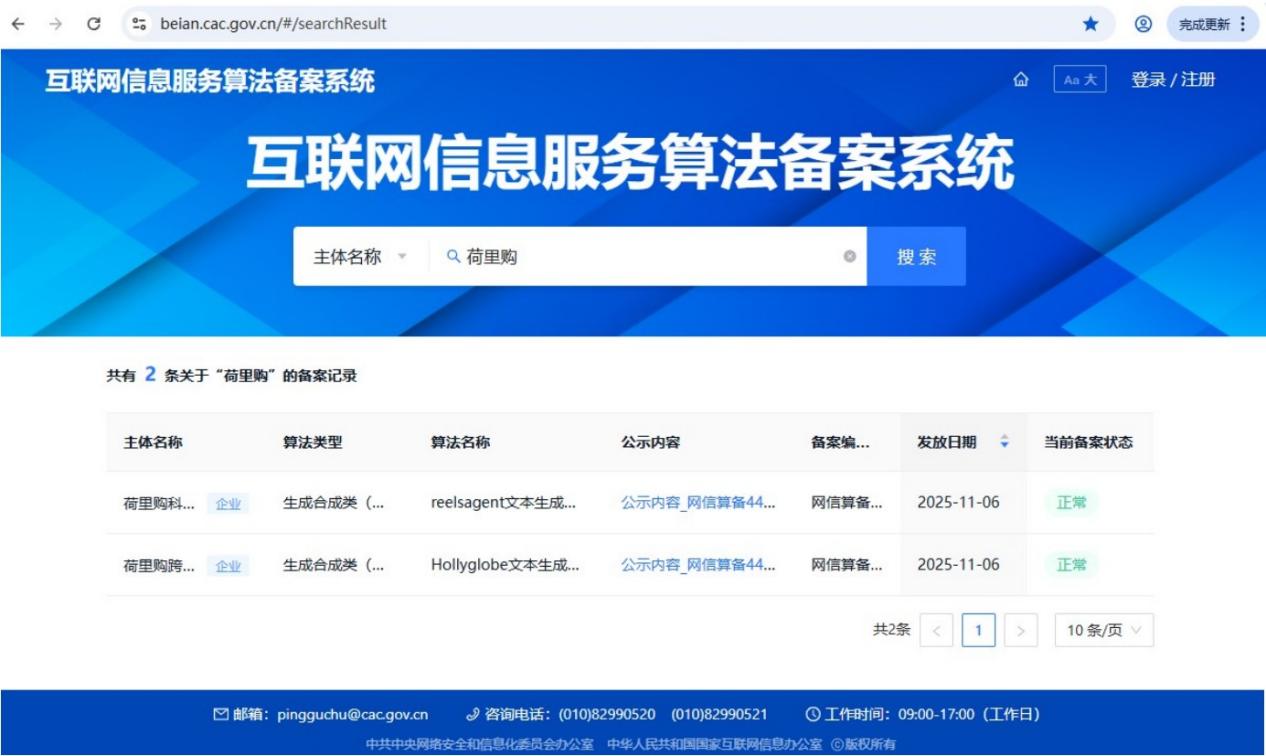
HollyGlobe AI recently cleared the second of those two: our self-developed HollyGlobe model passed the CAC's Generative AI Service Filing (Filing No. Guangdong-HollyGlobe-202606050174), adding to two Algorithm Filings we already held. That makes us the first GEO company in China to hold both national filings — and, as far as we've been able to verify, the first company built around a large language model purpose-built for AI search marketing.

HollyGlobe foundation model listed in Guangdong's Generative AI Service Filing announcement
HollyGlobe's two records in China's algorithm filing system

What each filing actually verifies

The two filings check different things. The Algorithm Filing reviews the specific content-generation algorithms a company runs — in our case, the text-generation systems behind ReelsAgent and HollyGlobe. The Generative AI Service Filing goes further: it evaluates the foundation model itself, testing generation accuracy and intent recognition against defined benchmarks, and auditing training-data legality, content filtering, and user privacy protections end to end. A vendor with only the first filing has had their output algorithms checked. A vendor with both has had the model underneath those algorithms checked too.

Why compliance in China isn't optional paperwork

For a domestic operator, skipping these filings mostly means regulatory exposure. For a multinational brand hiring that operator, the exposure transfers. If your GEO vendor is generating and distributing content on your behalf without the underlying filings, you're the one whose legal and compliance team has to explain that relationship later — to a board, an auditor, or a regulator. This is the same logic that shows up in our own FAQ when clients ask what credentials we hold: dual CAC filings plus ISO 27001 certification, because we treat compliance as a product capability, not paperwork we scramble for after the fact.

Where HollyGlobe fits

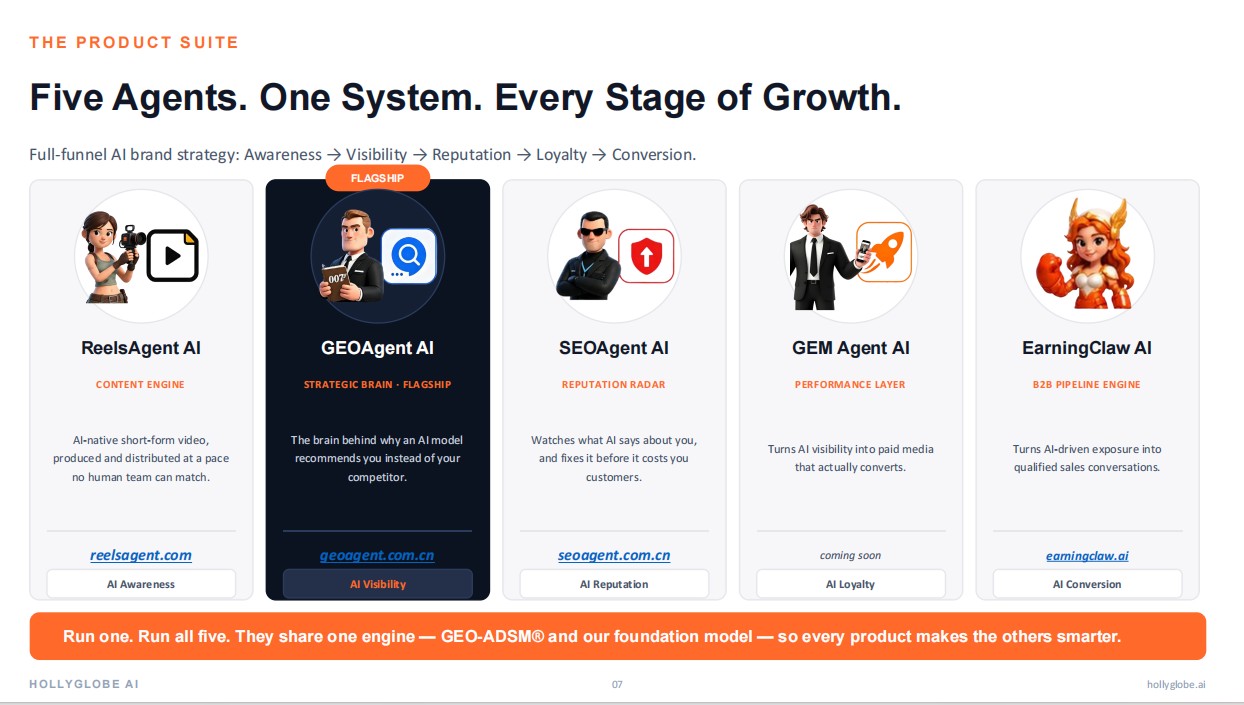
Our GEO-ADSM® framework — the same algorithm-decoding, monitoring, strategy, and distribution loop that runs GEOAgent AI, ReelsAgent AI, SEOAgent AI, and EarningClaw AI — sits on top of the technology that just cleared both filings. That's not a separate compliance layer bolted on for show; it's the actual infrastructure our products run on, in both the China and global AI ecosystems we serve.

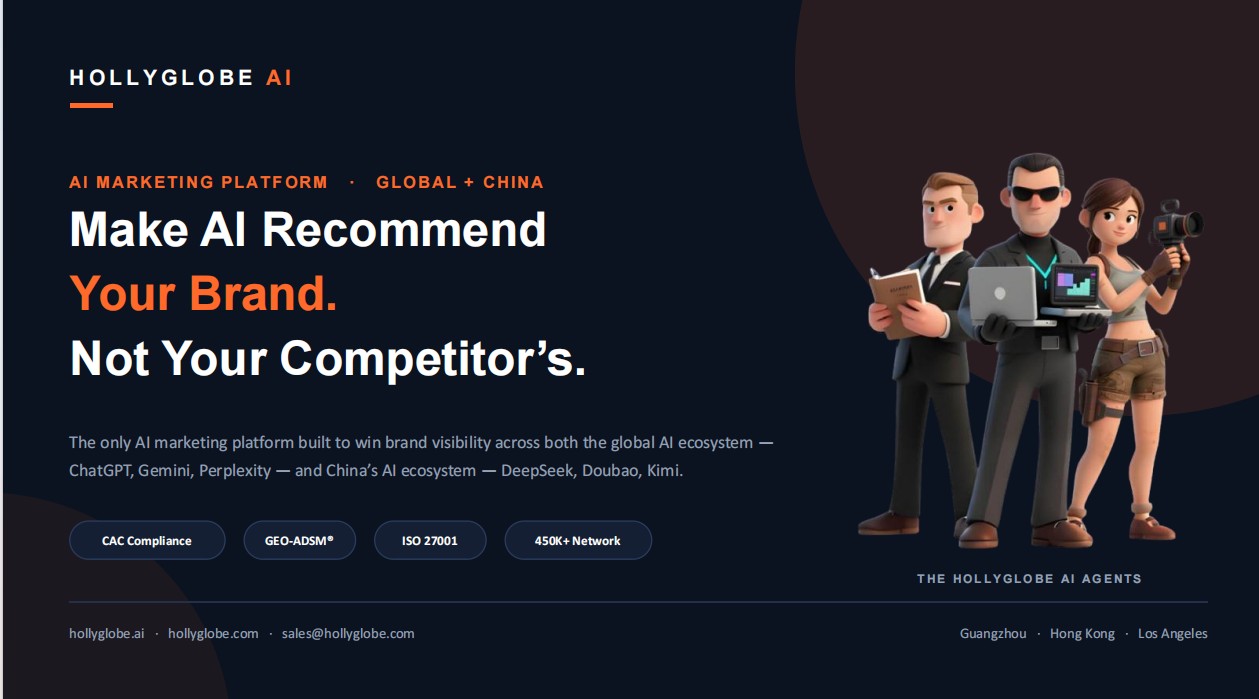
HollyGlobe AI marketing platform and Agent team
HollyGlobe's five-agent AI marketing product suite

What to ask your next vendor

Before you sign with any GEO vendor operating in China, ask for the filing numbers and check them directly on the CAC's public website — it takes a few minutes. It's a small step that filters out a meaningful amount of risk before it becomes your problem to solve.

HollyGlobe Becomes China's First GEO Company to Hold Both National AI Filings

HollyGlobe AI now holds both China's Generative AI Service Filing and Algorithm Filing, becoming the country's first GEO company with both national AI credentials.

The credential nobody used to ask about

A year ago, most brands evaluating a GEO vendor in China asked about case studies, pricing, and turnaround time. Almost nobody asked whether the vendor's underlying technology had actually been reviewed by the government. That question only became urgent after a wave of black-hat GEO operators — caught fabricating reviews and gaming AI recommendations at scale — was exposed on national television earlier this year.

HollyGlobe AI's self-developed foundation model, HollyGlobe, has now formally passed the Cyberspace Administration of China's (CAC) Generative AI Service Filing (Filing No. Guangdong-HollyGlobe-202606050174). Combined with two Algorithm Filings we secured earlier — for the ReelsAgent text-generation algorithm and the HollyGlobe text-generation algorithm — this makes HollyGlobe the first GEO company in China to hold both national filings: the Generative AI Service Filing and the Algorithm Filing. We're also the first company in the country built specifically around a vertical large language model for AI search marketing.

HollyGlobe foundation model listed in Guangdong's Generative AI Service Filing announcement
HollyGlobe's two records in China's algorithm filing system

What the filing review actually checks

The Generative AI Service Filing isn't a form you submit once and forget. Under China's Interim Measures for the Management of Generative AI Services, the review covers generation accuracy and intent-recognition performance against hard technical benchmarks, alongside a full audit of training-data legality, content-filtering mechanisms, and user privacy protection — including caps on the share of non-compliant material in training corpora and a requirement to maintain a dynamically updated risk-content blocklist. In practice, it's a full technical and compliance audit of how a company actually builds and ships content.

Why this took as long as it did

Our GEO-ADSM® framework — Algorithm Decoding, Data Monitoring, Strategy Generation, Media Distribution — is the engine behind every product we run. The HollyGlobe model that just cleared filing is the component responsible for content understanding and generation inside that loop. Passing this review meant our content-sourcing practices, filtering logic, and data-handling processes all had to hold up under direct regulatory scrutiny — not just work well enough to satisfy a client.

What it powers today

The framework this filing covers runs our full Agent suite: GEOAgent AI (geoagent.com.cn), the flagship product for decoding AI recommendation logic and generating content strategy; ReelsAgent AI (reelsagent.com), our AI-native short-video engine; SEOAgent AI (seoagent.com.cn), which tracks how AI models talk about a brand and helps correct negative signal; and EarningClaw AI (earningclaw.ai), which turns AI exposure into qualified B2B sales leads. GEM Agent AI, our performance layer, is currently in development and will close the loop between visibility and conversion.

HollyGlobe AI marketing platform and Agent team
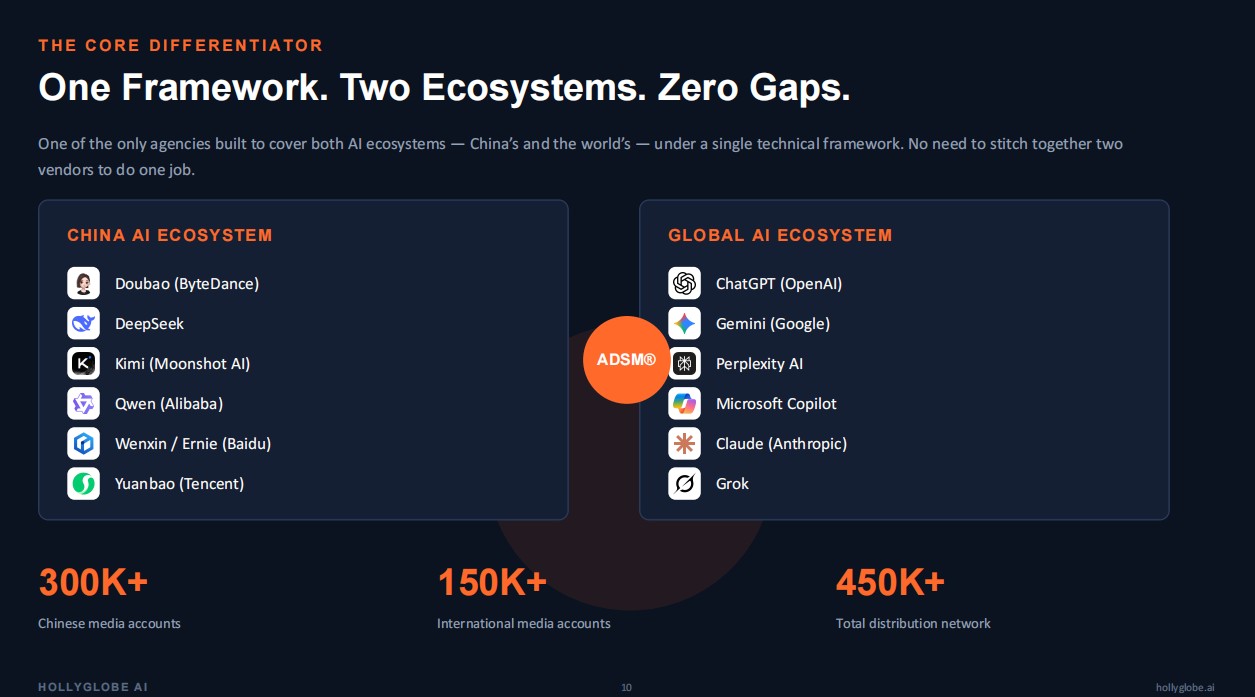
GEO-ADSM framework spanning China's and the global AI ecosystems

What changes from here

For compliance teams at public companies, state-linked institutions, and multinational brands entering China, this filing status is a hard prerequisite, not a nice-to-have. It won't make our products stronger overnight — but it does mean fewer conversations spent explaining why we're different from the vendors that made headlines this year, and more time spent on the actual work. The filing record is public and verifiable on the CAC's official website; we'd encourage anyone evaluating us to go check it directly.

Why Global Brands Go Invisible on China's AI Platforms -- And What to Do About It

Your brand might be well known in the West and completely absent from the one place hundreds of millions of Chinese consumers now start their research: Doubao, DeepSeek, Kimi, and Qwen. Ask any of these platforms which international bran…

The gap nobody's watching

Your brand might be well known in the West and completely absent from the one place hundreds of millions of Chinese consumers now start their research: Doubao, DeepSeek, Kimi, and Qwen. Ask any of these platforms which international brand leads a category, and the answer is often a domestic competitor -- not because your product is weaker, but because the model has never learned enough about you to say your name with confidence.

This isn't a translation problem. Multinational brands entering China typically have Chinese-language content -- product pages, a Tmall flagship store, maybe a WeChat account. What they don't have is a body of content structured the way Chinese AI platforms actually read it, distributed through the media network these platforms treat as trustworthy. That gap is invisible until the exact moment it matters: when a Chinese consumer asks an AI model for a recommendation, and your name doesn't come up.

Why this is different from Google

If your team has run SEO or SEM in China before, the instinct is to treat this the same way -- localize the content, run the campaign, watch the rankings. That playbook doesn't transfer cleanly. Chinese AI platforms sit on top of different content ecosystems entirely: Doubao leans on ByteDance's own network, Qwen leans on Alibaba's, and each one weighs authoritative Chinese-language media differently than Baidu ever did. A press release translated into Mandarin and pushed through a Western PR distribution service rarely reaches the sources these models actually trust.

There's also a compliance layer most international teams underestimate. Content generated or distributed by AI systems in China falls under real regulatory oversight -- algorithm filings and large-model filings from the Cyberspace Administration of China aren't paperwork, they're the entry ticket. A vendor without them isn't just less effective. They're a compliance risk for a multinational with a brand to protect.

What actually works

The brands getting this right are doing three things. First, they're building a structured knowledge graph of the brand in Mandarin -- not translated marketing copy, but content organized the way Chinese AI models parse authority: clear entity definitions, verifiable claims, and a consistent name across every channel. Second, they're publishing through Chinese authoritative media networks that these platforms already trust, rather than assuming their existing PR relationships carry over. Third, they're treating this as a distinct workstream from their global GEO strategy, with its own monitoring and its own compliance review -- not a copy-paste of what works in English.

HollyGlobe's position: one framework, two ecosystems

HollyGlobe was built in Guangzhou with Hong Kong as our international hub specifically to solve this problem -- for Chinese brands going global, and just as much for global brands entering China. Our GEO-ADSM® framework runs the same algorithm-decoding, monitoring, strategy, and distribution loop across both ecosystems, so a multinational doesn't need to run a separate vendor relationship for China. We hold the dual compliance filings from the Cyberspace Administration of China that let us operate credibly in this market, plus ISO 27001 certification for the data-handling standards a global brand's legal team will actually ask about.

The window is open, but it won't stay that way

China's AI-native user base is already in the hundreds of millions and growing. Brands that establish citation authority now -- before every competitor in their category has a China GEO strategy -- get a compounding advantage that's expensive to catch up to later. If your brand is well established globally but has never checked what Doubao or DeepSeek says about it, that's worth five minutes today.

GEO and AEO, Unified: How Global Brands Win the Answer -- Everywhere Their Customers Ask

A global brand's customer in Sao Paulo asks ChatGPT. One in Berlin asks Gemini or Copilot. One in Shanghai asks Doubao. One in Singapore might ask Perplexity or DeepSeek. Different platforms, different training data, different citation l…

One customer, five different AI platforms

A global brand's customer in Sao Paulo asks ChatGPT. One in Berlin asks Gemini or Copilot. One in Shanghai asks Doubao. One in Singapore might ask Perplexity or DeepSeek. Different platforms, different training data, different citation logic -- but the underlying question every marketing team needs answered is the same one: does the AI recommend us, and does it get us right?

Most global brands are approaching this market by market, tool by tool, if they're approaching it at all. That's the wrong shape for the problem. AI visibility isn't a regional campaign you localize -- it's a structural layer of brand infrastructure that has to work everywhere your customers are asking, at the same time.

GEO, AEO -- same fight, different flag

You'll see two terms used for roughly the same discipline: Generative Engine Optimization (GEO), which grew up around tools like ChatGPT and DeepSeek, and Answer Engine Optimization (AEO), which has roots in optimizing for search engines' featured-answer boxes. The line between them has mostly disappeared. Whether an agency calls itself a GEO agency, an AEO agency, or increasingly an LLMO (large language model optimization) shop, the underlying work is the same: structured content, verifiable authority, and a citation network the model actually trusts.

What should matter more to a global brand than the label is capability. Can this vendor prove algorithm-decoding results with real numbers? Do they have working experience across the platforms your actual customers use -- not just the one or two everyone talks about? If you sell into China as well as the West, can they operate in both ecosystems without you hiring a second agency?

The trap of a single-market strategy

We regularly see brands that have done excellent GEO work in English -- strong ChatGPT and Gemini visibility, a solid Perplexity presence -- and then discover their AI visibility in China is close to zero, because none of that content, structure, or media relationships transfers. Chinese AI platforms run on different training ecosystems and different authoritative media networks entirely. The reverse is just as common: Chinese brands with strong domestic AI visibility who are functionally invisible on ChatGPT and Gemini the moment they try to expand.

A genuinely global GEO/AEO strategy has to be built with both ecosystems in mind from day one -- not as an English program with a China add-on bolted on eighteen months later.

What HollyGlobe brings to this problem

HollyGlobe runs one technical framework, GEO-ADSM®, across both worlds: Doubao, DeepSeek, Kimi, and Qwen on one side; ChatGPT, Gemini, Perplexity, Copilot, and Grok on the other. Same algorithm-decoding discipline, same hourly monitoring, same distribution logic -- adapted to how each ecosystem actually works, not a single template stretched across all of them. For a brand operating globally, that means one relationship instead of two, and a strategy that's coherent across every market instead of a patchwork.

Where to start

If you're a global brand, the fastest way to see where you stand is the simplest one: ask ChatGPT, Gemini, and (if China matters to your business) Doubao or DeepSeek the exact questions your customers ask before they buy. Compare what comes back. The gaps you find are the roadmap.

When AI Started Selling Ads: What ChatGPT Ads Actually Means for Marketers

In June 2026, OpenAI quietly published a full set of advertising policy documentation. No leak, no rumor -- a straightforward product launch: ChatGPT Ads, managed through OpenAI Ads Manager Beta. If you're a CMO or a growth lead, this ne…

The announcement that mattered more than it seemed to

In June 2026, OpenAI quietly published a full set of advertising policy documentation. No leak, no rumor -- a straightforward product launch: ChatGPT Ads, managed through OpenAI Ads Manager Beta. If you're a CMO or a growth lead, this news probably got lost in the general noise of AI headlines. It shouldn't have. This is the moment the AI answer economy became a paid media channel for the first time -- and understanding exactly what it does, and doesn't, buy you is now a genuinely important piece of marketing literacy.

What the ad unit actually looks like

Per OpenAI's own documentation, ChatGPT ads appear as a clearly labeled "Sponsored" unit directly below a chat response -- never inside the answer itself, and never altering what the model says. Each unit includes a brand name and logo, a short headline, brief description copy, a landing-page link, and creative imagery. Pricing runs on CPM or CPC, decided through a relevance-weighted second-price auction. Only Free and Go-tier users see ads at all -- paying subscribers on Plus, Pro, Business, and Enterprise plans don't, and neither do users the system identifies as under 18. As of this writing, the ad platform is live in the US, UK, Canada, Australia, and New Zealand; China is not on the list.

The line OpenAI draws, in their own words

Here's the sentence that matters most in the entire announcement: "Ads do not influence the answers you get from ChatGPT." Read that plainly, and it says something important to every brand marketer paying attention -- you can buy a placement below the answer, but you cannot buy your way into the answer itself. Whether ChatGPT recommends you in the body of its response has nothing to do with your ad budget.

That's the real distinction to internalize: an ad slot and a recommendation slot are two completely different things, governed by two completely different mechanisms. One is auction-based. The other is earned -- built through the same kind of source authority, structural clarity, and citation density that determines whether any AI model trusts you enough to name you.

What actually earns the recommendation

AI models generate answers by drawing on sources they've learned to trust: authoritative media coverage, structured knowledge with clear entity definitions, and content that maps cleanly onto the way people actually ask questions. A brand that has never built this kind of structured, citable presence is functionally invisible to the model, regardless of how well the product sells or how large the ad budget is. This is the discipline known as GEO -- Generative Engine Optimization -- and it's the layer that determines whether you show up in the answer, not just below it.

Three things worth acting on

First, run a diagnosis before you run a strategy. Ask ChatGPT, Doubao, and DeepSeek the exact questions your buyers ask, and see whether you show up, and whether the description is accurate. Second, treat ad spend and GEO investment as two separate budget lines solving two separate problems -- don't expect one to substitute for the other. Third, if China matters to your business, remember that Doubao, DeepSeek, and Kimi have no advertising system at all right now -- which means the only lever that moves your visibility there is GEO, and the window to build that advantage early is open right now.

ChatGPT Ads is a milestone, not an endpoint. It confirms that AI answer surfaces are now valuable enough to monetize -- but the deeper competitive advantage still belongs to brands doing the harder, slower work of earning the model's trust directly.

What Is GEO? The Discipline Every Marketing Leader Needs to Understand in 2026

Open ChatGPT or Doubao and type "best [your category] brand." Does your company show up? If it doesn't, one of your competitors is being handed to your next customer while you're reading this sentence. That's not a hypothetical -- it's h…

A question worth asking right now

Open ChatGPT or Doubao and type "best [your category] brand." Does your company show up? If it doesn't, one of your competitors is being handed to your next customer while you're reading this sentence. That's not a hypothetical -- it's happening at scale, right now, as AI-native search adoption climbs past hundreds of millions of active users globally.

The discipline built to answer that question is called GEO: Generative Engine Optimization.

The simplest possible explanation

GEO is the practice of making sure your real brand content is something AI models can understand, trust, and cite. If you've worked in SEO, the analogy helps: SEO gets your website ranked highly in a search engine. GEO gets your brand recommended directly in the answer an AI model generates. The mechanics aren't the same. Search ranking responds to keywords and backlinks. AI recommendation responds to something more layered -- source authority, structural clarity, semantic relevance, the breadth of your citation network, and how strong your professional signal is in a specific context. In plain terms: an AI model recommends the brand that exists, clearly and credibly, inside its own picture of the world -- not the brand with the highest sales volume or the biggest ad budget.

Why this can't wait

The first reason is timing. GEO today looks a lot like social media marketing looked around 2010 -- brands that built early authority compounded that advantage for years, and late movers paid a structural tax to catch up. The second reason is bigger: AI agents are coming. As AI shifts from generating a list of options to directly executing a decision -- booking, ordering, choosing -- a brand's absence stops costing it "a missed recommendation" and starts costing it "permanent exclusion from an automated purchase flow." Building citation authority now is positioning for that higher-stakes future before it arrives. The third reason is simpler: the returns on traditional channels are flattening, while AI recommendation remains a comparatively early, comparatively less contested field.

What real GEO capability requires

Doing this properly takes three things that are genuinely hard to build in-house: continuous, technical decoding of how each major AI platform actually decides what to recommend; a distribution network large enough to reach the sources these platforms already trust; and infrastructure to monitor AI-platform data on an hourly basis, not a monthly one. Building all three from scratch usually costs more, and takes longer, than working with a team that already has them.

Where HollyGlobe fits

HollyGlobe's GEOAgent AI platform is built around exactly these three capabilities. Our proprietary GEO-ADSM® framework runs a continuous algorithm-decoding, monitoring, strategy, and distribution loop -- 95% match accuracy on core-industry algorithms, hourly data updates against an industry norm closer to weekly, and dual national compliance filings from the Cyberspace Administration of China. We've helped brands across healthcare, consumer goods, B2B manufacturing, education, and finance build measurable AI recommendation authority across Doubao, DeepSeek, Kimi, ChatGPT, and Gemini.

The takeaway

GEO isn't a passing marketing buzzword -- it's a structural question about whether your brand exists in the world AI now mediates for hundreds of millions of people. The fastest way to know where you stand is the one we opened with: open an AI platform, ask the question your customer would ask, and see what comes back.

GEO vs. SEO: What's Actually Different (And Why You Need Both)

"We already have a strong SEO program. Do we really need GEO too?" Yes -- and the reason isn't a sales pitch, it's mechanical. SEO and GEO are evaluated by two different systems, and doing well in one doesn't automatically move the needl…

The question we hear most often

"We already have a strong SEO program. Do we really need GEO too?" Yes -- and the reason isn't a sales pitch, it's mechanical. SEO and GEO are evaluated by two different systems, and doing well in one doesn't automatically move the needle on the other. Here's the comparison broken down properly.

Different optimization target

SEO optimizes for a search engine's keyword-ranking algorithm -- keyword density, backlinks, page speed, mobile performance. GEO optimizes for how a large language model decides what to cite -- entity completeness, breadth of authoritative citation, structural data compatibility, semantic relevance. They share some underlying DNA, but a strong SEO ranking does not automatically translate into AI recommendation authority. They're evaluated by fundamentally different logic.

Different output for the user

Traditional search hands the user a list of links and lets them choose. AI search hands the user one answer, and most people take it at face value without cross-checking. That raises the competitive stakes considerably -- in the SEO era, ranking fifth still got you clicks. In the GEO era, if the model doesn't mention you, the user may never know you exist at all.

Different content format wins

The SEO era rewarded long-form articles, keyword-dense landing pages, and heavy backlink building. AI models show a clear preference for structured FAQ-style content, information published through sources it already trusts, and scenario-specific answers over generic brand copy. A common mistake we see: brands assume publishing more content automatically improves AI visibility. It doesn't. Volume without algorithm-informed structure can actually get flagged as noise and hurt your standing.

Different pace of change

Traditional search rankings shift on a weekly or monthly cadence, and the underlying algorithm updates are relatively predictable. AI platforms move faster -- which is why GEOAgent AI runs hourly monitoring against an industry standard that's typically weekly. If a competitor's move shifts AI sentiment, you want to know within the hour, not the following Monday.

Complementary, not competing

To be clear: GEO doesn't replace SEO. As AI-driven search adoption grows, brands need visibility across both traditional search engines and AI platforms simultaneously. In practice, we've found that well-structured, authoritative content built for GEO purposes often lifts traditional SEO performance too -- AI-friendly content tends to be more rigorous and more credible content, full stop.

A five-minute self-check

Open Doubao or DeepSeek, ask three to five of the exact questions your customers ask most often in your category, and see whether your brand appears -- and whether it's described accurately. If the answer is no, there's a structural gap between your SEO scorecard and your actual AI visibility, and it's worth closing before a competitor closes it first. HollyGlobe's GEOAgent AI platform, built on our proprietary GEO-ADSM® framework, exists specifically to close that gap -- not by abandoning your SEO investment, but by adding the layer the AI era now requires on top of it.

What Makes a Great GEO Team: A Buyer's Checklist Before You Sign a Contract

That's the first assumption most marketing teams make when they hear "GEO" for the first time. It's an understandable guess -- write some brand copy, publish it, wait to get picked up. It's also wrong. GEO's actual job is figuring out wh…

"Isn't this just content writing with a new name?"

That's the first assumption most marketing teams make when they hear "GEO" for the first time. It's an understandable guess -- write some brand copy, publish it, wait to get picked up. It's also wrong. GEO's actual job is figuring out why an AI model cites a competitor instead of you, and that requires a set of capabilities most content teams simply don't have. Here's what to look for before you hire anyone.

Capability one: real algorithmic research, not guesswork

The teams that get this right don't stop at "the AI didn't mention us." They dig into which sources the model actually cited, which specific passage, and why that passage specifically. Every industry has a different pattern of trusted sources -- what works for a healthcare brand and what works for a consumer brand are two entirely different systems. A serious GEO team should be able to show you industry-specific decoding methodology, not a single template reused for every client.

Capability two: structured content production

AI models have clear structural preferences -- clean entity recognition, FAQ-formatted content, tightly organized semantic relationships. A capable GEO team can take your scattered product information, expert credentials, and case data and rebuild it into something a model can actually parse -- not just repost your existing marketing brochure online.

Capability three: building EEAT-level trust

EEAT -- Experience, Expertise, Authoritativeness, Trustworthiness -- is the framework AI models effectively use to judge credibility. A real GEO team understands how to build that trust through authoritative source citation, structured expert profiles, and verifiable credential markup, rather than relying on brand copy that just asserts its own credibility.

Capability four: actual distribution execution

Strategy without execution is a slide deck. Effective GEO requires a distribution network broad enough -- news media, vertical industry platforms, social channels -- to actually place structured content inside the sources AI models already trust. When evaluating a vendor, ask less about how good their strategy sounds and more about what media relationships they can actually put to work.

Capability five: a hard line on white-hat practice

This one matters most. GEO tools can be misused -- mass-producing fabricated claims, faking reviews, manipulating what a model believes. That's not just unethical, it's a real compliance and brand-safety risk. A trustworthy GEO team builds everything from your real information and refuses work that requires fabrication. The fastest way to check: does the vendor hold real algorithm filings with relevant regulators, and do they have an actual content compliance review process, or just a promise?

How HollyGlobe approaches this

HollyGlobe holds dual national compliance filings from the Cyberspace Administration of China -- an Algorithm Filing and a Large Model Filing -- plus ISO 27001 certification, a combination that's genuinely uncommon among GEO providers. Our team is built around these five capabilities directly: GEO-ADSM® handles algorithm decoding and strategy, ReelsAgent AI handles structured content production, and our media network handles distribution -- with every deliverable built from real client information.

If you're evaluating GEO vendors, use this list as your actual diagnostic -- not the polish of their pitch deck.

AEO vs. GEO: Same Fight, Different Name?

If you've been reading about AI search lately, you've likely run into both GEO (Generative Engine Optimization) and AEO (Answer Engine Optimization) -- sometimes used interchangeably, sometimes debated as if they're meaningfully differen…

Two acronyms, one question

If you've been reading about AI search lately, you've likely run into both GEO (Generative Engine Optimization) and AEO (Answer Engine Optimization) -- sometimes used interchangeably, sometimes debated as if they're meaningfully different disciplines. Clients evaluating an Answer Engine Optimization Agency versus a GEO agency often ask us directly whether it matters which one they hire.

Where the terms actually came from

AEO has older roots -- it was originally used to describe optimizing for featured snippets and answer boxes inside traditional search engines like Google. GEO emerged more recently, specifically around the rise of generative AI tools like ChatGPT, Doubao, and DeepSeek, focused on how large language models construct and cite generated answers. The starting points differ slightly. The end goal is nearly identical: get your brand surfaced as the direct answer, not buried in a list of links.

Why "GEO" is winning as the umbrella term

As generative AI became the dominant paradigm across the industry, GEO increasingly emerged as the broader term -- covering everything from classic answer-box optimization to chatbot citation to, eventually, brand positioning inside AI agent decision-making. That's why you'll now see GEO agencies referencing GEO, AEO, and LLMO (large language model optimization) side by side on the same page. Underneath the naming, it's the same core capability set.

What actually matters when you're buying

Whatever label a vendor uses -- GEO agency, AEO agency, or Answer Engine Optimization company -- the real diligence questions are the same. Can they show verifiable algorithm-decoding results with real data, not just case study language? Do they have working experience across the specific platforms your customers actually use? If your market includes China, can they operate credibly across both the domestic and international AI ecosystems, or will you need a second vendor?

HollyGlobe is one of the few GEO providers built to cover both ecosystems from day one -- Doubao, DeepSeek, Kimi, and Qwen on the domestic side; ChatGPT, Gemini, and Perplexity internationally -- through the same GEO-ADSM® framework. For brands with global ambitions or dual-market operations, that dual coverage tends to matter more in practice than which acronym is on the agency's homepage.

The bottom line

Terminology will keep shifting. The underlying question won't: when AI generates an answer, is your brand in it? That's what GEO, AEO, and every close cousin of those terms are actually trying to solve. HollyGlobe's focus has never been the label -- it's building the systems that answer that question with a yes.

The Agent Era Is Coming: Why "Being Recommended" Won't Be Enough

The center of gravity in how people use AI is moving from getting information to getting things done. Today, a user asks a question and an AI model hands back a set of recommendations for the user to sort through. Increasingly, that's ch…

A shift that's closer than it looks

The center of gravity in how people use AI is moving from getting information to getting things done. Today, a user asks a question and an AI model hands back a set of recommendations for the user to sort through. Increasingly, that's changing -- a user gives an instruction, and an AI agent independently researches, compares, and completes the transaction, with no list of options ever shown. That shift rewrites the competitive question for every brand: today, the goal is being cited as an authoritative source in an AI-generated answer. Tomorrow, the goal is being the default the agent chooses without being asked.

What "one result" instead of "a list" actually means

When an AI agent filters through available options and executes a decision directly, it doesn't output a list -- it outputs a single outcome. A brand that isn't selected doesn't just rank low. It doesn't appear at all. That's a more absolute, more silent form of elimination than anything traditional search ranking ever produced. In the old model, ranking eighth still meant a user might scroll and find you. In the agent model, if you're not chosen, there may be no visibility event at all.

Why building GEO authority now is the actual preparation for that future

Here's the part that's easy to miss: the knowledge base an AI agent draws on to make a decision is fundamentally the same knowledge base an AI model uses today to generate an answer. The structured content, the citation breadth, the semantic authority a brand builds today for GEO purposes is precisely the material an agent will reference when it's making an autonomous choice tomorrow. Brands that skip GEO now aren't just missing today's recommendation -- they're forfeiting eligibility for tomorrow's default-selection status before the game has really started.

HollyGlobe's read on where this is going

This is why HollyGlobe frames its work as building a brand's AI-wide knowledge asset, not simply "improving AI visibility." Through our GEO-ADSM® framework -- algorithm decoding, monitoring, strategy, distribution, running in a continuous loop -- and a distribution network built for citation, we help brands build structured, credible, durable knowledge assets now. That asset doesn't expire when AI interaction shifts from chat to autonomous execution. It becomes the foundation the next phase runs on.

What to actually do right now

You don't need to wait for AI agents to fully arrive before acting. What you can do today is turn your brand's core information, expertise, and credibility into content structured well enough for an AI model to understand and trust -- work that holds its value regardless of how the interaction model evolves from here. A brand that isn't recommended today has no visibility event tomorrow, when the stakes are higher and the margin for correction is gone. That sentence will be more true a year from now than it is today.

From Spec Sheet to Solution: How a Manufacturer's AI Recommendation Rate Went From 5% to 78%

A manufacturer of traceability-marking equipment for food and pharmaceutical packaging -- exporting to more than 30 countries, with real technical depth in GS1 international standards and pharmaceutical GMP compliance -- had a problem no…

Reduced to a line item in a spec comparison

A manufacturer of traceability-marking equipment for food and pharmaceutical packaging -- exporting to more than 30 countries, with real technical depth in GS1 international standards and pharmaceutical GMP compliance -- had a problem no amount of engineering talent could fix on its own. When a pharmaceutical procurement manager asked an AI platform about traceability-code marking equipment, the answer came back as a flat spec comparison. The company's actual capability -- full compliance-solution design, not just equipment -- was invisible. Its AI recommendation rate sat at 5%.

The comment that exposed the real problem

The wake-up call came from a longtime customer, a procurement lead at a listed pharmaceutical company, who put it plainly: "Your product line covers everything, your integration support is solid -- but when I recommend you to a peer company and they check AI, all they find is a laser-equipment price comparison. They have no idea you do full compliance solutions." That sentence landed hard. The company had long since evolved past selling machines -- it was designing full solutions spanning equipment selection, production-line integration, compliance consulting, and export-market standards adaptation. None of that showed up in the one place an increasing share of buyers now check first.

The fix: redefining what the AI actually knows

Working with HollyGlobe's GEOAgent AI, the team ran algorithm decoding specific to B2B procurement queries and found a clear pattern: AI platforms weight industry-specific expertise, systematic solution description, and compliance-standard interpretation heavily when answering procurement-related questions. Equipment specs alone don't carry much signal.

From there, the work moved in three stages. First, a structural rebuild of the brand's knowledge graph -- separating what had been a single undifferentiated product listing into distinct, well-defined knowledge units: industry vertical, solution architecture, compliance certification. Second, a content build specific to each served industry -- pharmaceutical, food, personal care -- each with a structured compliance guide marked up for machine readability. Third, distribution through an authoritative media network reaching pharmaceutical and food-industry trade publications, not just the company's own website.

The result: AI started pre-qualifying the right buyers

Within months, a procurement engineer searching for pharmaceutical secondary-packaging traceability solutions would see the company cited directly -- not as a spec line, but as a provider offering full-category traceability marking compliant with GS1 and GMP standards. The AI recommendation rate climbed from 5% to 78%, with the brand landing consistently in the top three for core procurement queries. Just as notably, deal values from AI-sourced inquiries ran roughly 30% higher than those from traditional trade shows and B2B marketplaces -- because buyers arriving through AI had already absorbed the compliance-solution narrative before ever speaking to sales.

The lesson for exporters and B2B manufacturers everywhere

The company's leadership summed it up well internally: in the eyes of an AI model, selling equipment and selling a solution are two entirely different identities. If you don't explicitly tell the model you're a solutions provider with deep vertical expertise, it will default to treating you as a line in a spec comparison -- regardless of how strong your actual engineering capability is. For B2B and export-oriented manufacturers evaluating GEO providers, that's the real test to apply: can this vendor actually change how AI defines your identity, not just how often it mentions your name?

Category Leader, AI No-Show: How a Consumer Brand Went From 13% to Top-Ranked

A hair-care brand had spent years earning the top sales position in its category through traditional e-commerce -- strong repeat purchase, real customer loyalty, category leadership by every conventional metric. Then leadership tried som…

Winning offline, invisible online -- in a way that actually mattered

A hair-care brand had spent years earning the top sales position in its category through traditional e-commerce -- strong repeat purchase, real customer loyalty, category leadership by every conventional metric. Then leadership tried something simple: search for the brand's own core selling points on a major AI platform. Nothing came back. Zero recommendation presence for queries the brand should have owned outright.

In a leadership review, the marketing director ran the search live -- typing in the exact questions real customers ask most often. Every recommendation that came back was a competitor, including brands with meaningfully lower sales volume. The company's leadership team realized, in real time, that years of e-commerce dominance carried zero weight in how AI models evaluate a brand. AI doesn't read sales rank. It reads sources.

Rebuilding around what AI actually values

Working with HollyGlobe's GEOAgent AI, the team ran a full scan of the brand's current standing across major AI platforms and mapped exactly where the "AI blank spots" were. From there, strategy generation worked backward from real customer intent -- rebuilding the brand's content around what AI platforms consistently reward: proprietary technology and formulation science, quantifiable and verifiable efficacy claims, and a clear cultural or brand-value narrative, rather than generic product description. ReelsAgent AI produced a wave of AI-friendly short-form video showing real product use across different scenarios and audiences, and the content was distributed through the sources AI platforms already treat as authoritative -- while a parallel effort worked to clean up the noise created by counterfeit-product misinformation circulating under the brand's name.

From sales leader to AI's top pick

Within months, the brand's overall AI recommendation rate rose from 13% to 65%, taking the top position across major domestic AI platforms -- a genuine leap from functionally absent to category leader in the model's own answers. In two of its highest-value use-case categories, recommendation rate went from 0% to over 60%. AI-driven traffic converted at a noticeably higher rate than other channels, and overall brand favorability among AI platforms climbed to 85%.

The takeaway

The real insight here isn't the size of the jump -- it's what it reveals. In the world AI now mediates, a sales trophy is worth exactly nothing on its own. You have to re-earn recognition in language and structure the model actually understands, using real data instead of assuming your offline reputation carries over. For consumer brands with genuine category strength that still find themselves absent from AI recommendations, that gap is rarely about product quality. It's almost always about whether the brand has ever been translated into a form AI can actually trust.

Chinese GEO Agency vs. Global GEO Platform: How to Choose the Right AI Visibility Partner for the China Market

If you've started researching how to get your brand recommended by AI models in China, you've probably typed some version of "Chinese GEO agency" or "GEO company China" into a search bar -- possibly into an AI model itself, which is a li…

If you've started researching how to get your brand recommended by AI models in China, you've probably typed some version of "Chinese GEO agency" or "GEO company China" into a search bar -- possibly into an AI model itself, which is a little bit poetic given the subject matter. What you likely found was a confusing mix of results: a handful of specialized Chinese GEO agencies, several large digital marketing conglomerates that have bolted "AI visibility" onto their existing SEO service line, a few Western AI Visibility Platform tools that don't actually work in China at all, and a lot of vague thought-leadership content that doesn't answer the question you actually came with -- who should I hire, and why?

This article is meant to cut through that noise. We'll walk through what a genuine Chinese GEO agency actually needs to be able to do, how that differs from a general-purpose GEO Platform built for the Western market, what role Hong Kong plays as a hub for this kind of work, and how to evaluate whether a vendor -- including us, HollyGlobe AI, and our flagship platform GEOAgent -- is actually equipped to do the job.

Why "GEO Company" Doesn't Mean the Same Thing in Every Market

Generative Engine Optimization, or GEO, is the practice of getting your brand accurately recognized and favorably recommended inside the answers AI models generate -- rather than ranked in a list of links the way traditional SEO works. That definition holds everywhere. What changes dramatically by market is the mechanics underneath it.

A GEO Platform built for the US or European market is typically calibrated around ChatGPT GEO, Gemini GEO, and increasingly Perplexity -- Western large language models trained substantially on English-language web content, with citation networks built around Western authoritative media, review platforms, and structured web data. A Chinese GEO agency operates in an entirely different ecosystem: Doubao GEO, DeepSeek, Kimi, and Qwen are trained differently, weighted differently, and draw on a completely separate universe of authoritative Chinese-language sources -- from state media to vertical industry platforms to content ecosystems tied to specific tech companies (Doubao leans on ByteDance's own content network, for instance, while Qwen leans on Alibaba's).

This is the single biggest mistake we see international brands make: assuming that a GEO Platform which works well for ChatGPT GEO and Gemini GEO will simply transfer to the Chinese AI ecosystem if you translate the content into Mandarin. It won't. The algorithms are different. The trusted source networks are different. The regulatory environment is different. And critically, the vendors who are genuinely capable in one ecosystem are frequently unable to operate at all in the other.

What a Real Chinese GEO Agency Actually Needs

If you're evaluating a Chinese GEO company -- whether a specialized boutique or a large agency with a China practice -- there are five capabilities worth checking for directly, rather than taking on faith.

First: verifiable algorithm decoding, not just monitoring. A lot of what gets marketed as an "AI Visibility Platform" in China is really just a dashboard that tracks whether your brand shows up in AI answers -- useful information, but not action. A genuine Chinese GEO agency should be able to explain, with real methodology, how Doubao GEO and DeepSeek actually decide what to recommend, and adjust strategy accordingly. This isn't guesswork; it's the product of continuous technical testing against these platforms, and it's the difference between a monitoring tool and a GEO Platform that actually moves your numbers.

Second: regulatory filings that are real and checkable. This is the part most international teams underestimate entirely. Any company generating or distributing AI-related content at scale in China is expected to operate under real regulatory oversight from the Cyberspace Administration of China (CAC) -- specifically, Algorithm Filings and Large Model Filings. A Chinese GEO agency without these filings isn't just operating with less rigor. For a multinational brand with legal and compliance teams watching vendor relationships closely, working with an unfiled vendor is a real risk, not a minor technicality. When you're vetting a Chinese GEO company, ask directly whether they hold CAC Algorithm Filing and Large Model Filing, and ask for the filing numbers. A legitimate agency will have them ready.

Third: a distribution network inside China's actual media ecosystem. Chinese AI platforms weight authoritative Chinese-language media heavily when deciding what to cite -- national outlets, vertical industry publications, platforms like Zhihu and Baidu's content ecosystem. A Western PR distribution list, or a translated press release pushed through an international newswire, essentially never reaches these sources. An AI search optimization agency operating in China needs an actual distribution network inside this ecosystem -- not a promise to "localize" your existing media list.

Fourth: Hong Kong as an operating bridge, not just a mailing address. A growing number of GEO agencies use Hong Kong as their international hub -- and there's a real reason for that beyond convenience. Hong Kong sits at the intersection of mainland Chinese regulatory and business norms and international commercial practice, which makes it a genuinely useful base for an agency serving both multinational clients entering China and Chinese brands expanding overseas. When evaluating a Hong Kong GEO agency, the question worth asking isn't just "are you based there" but "do you actually operate R&D and execution across both the mainland Chinese and international AI ecosystems from that base, or is Hong Kong just where the invoice comes from."

Fifth: platform breadth, not platform depth in just one place. A Chinese GEO agency that only handles Doubao GEO, or only handles DeepSeek, is solving half the problem. Chinese consumers and business buyers move fluidly across Doubao, DeepSeek, Kimi, and Qwen -- and increasingly, if your brand also needs Western visibility, across ChatGPT GEO and Gemini GEO too. The strongest AI Visibility Platforms cover multiple platforms under one strategy, not one platform in isolation.

Where HollyGlobe AI Fits

We built HollyGlobe AI and our flagship GEO Platform, GEOAgent, specifically to answer this question honestly rather than paper over it. We're headquartered in Guangzhou, in China's Greater Bay Area, with Hong Kong as our international hub -- genuinely operating as a bridge between the two ecosystems rather than claiming coverage we don't have. Our proprietary GEO-ADSM® framework runs continuous algorithm decoding, hourly monitoring, strategy generation, and media distribution across Doubao, DeepSeek, Kimi, and Qwen on the Chinese side, and ChatGPT, Gemini, Perplexity, Copilot, and Grok internationally -- the same technical framework, adapted to how each ecosystem actually works.

We hold the dual national compliance filings that matter here -- an Algorithm Filing and a Large Model Filing from the Cyberspace Administration of China -- along with ISO 27001 certification for data handling, which tends to matter a great deal to multinational legal teams evaluating a new China-facing vendor. Our distribution network reaches hundreds of thousands of authoritative Chinese and international media accounts, which is the infrastructure layer that turns a content strategy into actual AI-model citations rather than a folder of unpublished drafts.

A Practical Way to Start Evaluating Anyone -- Including Us

Before you sign with any Chinese GEO agency, run a simple test. Open Doubao, DeepSeek, and Kimi, and ask the exact questions your Chinese customers would ask before choosing a brand in your category. See what comes back. Then ask any vendor you're evaluating -- including HollyGlobe AI -- to walk you through exactly what they would do differently, with what methodology, and what compliance credentials back that work up. A GEO Platform is only as good as its ability to explain, in specific and checkable terms, why an AI model would start recommending you instead of a competitor. If a vendor can't answer that clearly, that's the answer.

Red Flags Worth Watching For

Because GEO is still a relatively young discipline, the vendor landscape includes a wide range of quality -- and some practices that should make you walk away entirely. Be cautious of any Chinese GEO company that guarantees a specific recommendation rate within a fixed timeframe without first running a diagnostic on your current standing; AI platform algorithms shift constantly, and a credible agency will frame timelines as ranges based on real prior engagements, not fixed promises. Be equally cautious of any vendor whose strategy leans heavily on mass-producing near-identical content across many domains, or manufacturing reviews and testimonials -- this kind of "content flooding" doesn't just fail to work, it can actively damage a brand's standing once an AI platform's own quality filters start treating that content as noise or, worse, as manipulation. A legitimate AI search optimization agency builds from your real product information, your real case studies, and your real expert credentials -- not from fabricated claims dressed up to look authoritative.

Another red flag: a Chinese GEO agency that can't clearly separate its GEO work from generic SEO or social media services. These are related disciplines, but they are evaluated by fundamentally different systems -- a search engine ranking algorithm versus a language model's citation logic. If a vendor's pitch deck uses "SEO" and "GEO" interchangeably throughout, that's often a sign they haven't actually built dedicated algorithm-decoding capability for AI platforms and are relabeling existing SEO services.

How Pricing Typically Works

Most Chinese GEO agencies and GEO Platforms price in one of two ways: a standardized subscription model, where you pay an annual or monthly fee for access to a platform's monitoring, strategy, and content tools at a defined tier (often something like Standard, Professional, and Enterprise levels), or a fully managed engagement, where the agency runs the entire process -- strategy, content production, distribution, and monitoring -- for a custom fee tied to your industry, the number of target AI platforms, and your traffic or visibility goals. Subscription models tend to suit brands with an internal marketing team that can execute on strategic recommendations; fully managed engagements tend to suit brands that want the entire workstream handled end to end. Neither model is inherently better -- the right choice depends on how much internal capacity you have to execute against a GEO strategy once you have one.

The Compliance Question International Legal Teams Always Ask

If you work at a multinational company, there's a good chance your legal or procurement team will ask a version of this question the moment "China" and "AI content generation" appear in the same sentence: is this vendor operating in a way that creates regulatory exposure for us? It's a fair question, and it deserves a specific answer, not a reassurance. In China, any organization generating or distributing content through AI systems at scale is expected to hold specific national filings -- an Algorithm Filing and, where applicable, a Large Model Filing, both issued by the Cyberspace Administration of China. These aren't optional best practices; they're the baseline that lets an agency operate credibly and legally at scale. When a Chinese GEO agency can produce actual filing numbers on request, that's a strong signal they've built their business around operating correctly, not around moving fast and hoping nobody asks. Pair that with an international certification like ISO 27001, which speaks to how your brand and customer data is actually handled, and you have the two pieces of documentation most legal teams will want to see before a contract gets signed.

Frequently Asked Questions From Brands Evaluating This Market

Do we need a separate vendor for China versus our global GEO strategy? Not necessarily -- but you do need a vendor with genuine operating capability in both ecosystems, not a Western AI Visibility Platform that has simply added a China page to its website without the underlying algorithm-decoding, compliance filings, or media network to back it up. Ask directly what percentage of the agency's actual client work and technical infrastructure is built for the Chinese AI ecosystem versus repackaged from their Western offering.

How long does it typically take to see results in the Chinese market specifically? This varies by agency and by category, but as a general benchmark, most well-executed GEO programs in China show a measurable shift in AI recommendation rate within four to eight weeks of full deployment, with multi-platform results compounding over three to six months. Treat any promise significantly faster than that with some skepticism, and treat any agency that can't give you a benchmark at all with more.

Is Hong Kong or mainland China a better base for a GEO partner? It depends on what you need. A Hong Kong GEO agency with genuine mainland execution capability -- R&D, media relationships, and compliance filings that actually reach into mainland China -- offers a practical middle ground for multinational clients who want an easier legal and operational interface while still getting full access to the mainland Chinese AI ecosystem. What matters is verifying the execution reaches mainland China, not just the headquarters address.

Choosing a Chinese GEO agency is ultimately a technical due-diligence exercise dressed up as a marketing decision. The brands that get this right treat it that way -- checking filings, checking methodology, checking platform breadth -- rather than choosing based on the most polished pitch deck in the room.

ChatGPT GEO, Gemini GEO, and Doubao GEO: Why One-Platform Optimization Isn't Enough Anymore

Somewhere in the last eighteen months, "which AI platform should we optimize for" quietly became one of the most consequential questions in marketing -- and most brands are still answering it wrong, because they're answering a version of…

Somewhere in the last eighteen months, "which AI platform should we optimize for" quietly became one of the most consequential questions in marketing -- and most brands are still answering it wrong, because they're answering a version of the question that no longer exists. The real world isn't ChatGPT versus Gemini versus Doubao. It's all three, plus DeepSeek, plus Kimi, plus Perplexity, running simultaneously, each with its own citation logic, each capturing a meaningful and different slice of the people researching your category before they buy.

This piece is about why single-platform GEO strategies are quietly leaving revenue on the table, what's actually different about how ChatGPT GEO, Gemini GEO, and Doubao GEO work under the hood, and what a genuinely multi-platform GEO Platform needs to do to keep up.

The Single-Platform Trap

It's an easy trap to fall into, because it mirrors how most marketing teams historically operated. In the SEO era, you optimized primarily for Google, because Google commanded the overwhelming majority of search volume in most Western markets, and Baidu played that role in China. One dominant platform, one primary optimization target. That world doesn't exist anymore, and it's not coming back.

Today, a B2B buyer might research a vendor primarily through ChatGPT, while a consumer shopping for skincare might default to Gemini because it's built into their Android phone, while a Chinese consumer researching the same skincare category is almost certainly asking Doubao, DeepSeek, or Kimi -- three platforms with meaningfully different citation behavior from each other, let alone from the Western models. A brand that optimizes only for ChatGPT GEO and calls the job done is, in practice, optimizing for a fraction of the actual AI-driven research happening about their category -- and often the easier, more heavily contested fraction, since ChatGPT GEO and Gemini GEO get the overwhelming share of the industry's attention while Doubao GEO and Kimi remain comparatively under-addressed.

What's Actually Different About Each Platform

ChatGPT GEO rewards content with strong general web authority, structural clarity, and citation density across a broad range of sources. OpenAI has been explicit that its advertising system, launched in 2026, does not influence what the model recommends in the body of an answer -- meaning ChatGPT GEO is still, at its core, a question of earning citation authority the model already trusts, not a paid placement question.

Gemini GEO operates differently in some meaningful ways, given its deep integration with Google's existing search index and knowledge graph infrastructure. Content that has already built strong traditional SEO signal -- structured data, established domain authority, consistent entity information across the web -- tends to have a real head start in Gemini's citation behavior, more so than with some other models. This is one of the few places where legacy SEO investment and GEO investment compound each other directly.

Doubao GEO sits inside ByteDance's broader content ecosystem, and it shows. Doubao's citation behavior leans toward content that performs well within ByteDance-adjacent platforms -- think Toutiao and Douyin's own content ecosystem -- more than a typical Western model would. A brand that wants strong Doubao GEO performance needs a presence that extends into these platforms specifically, not just a generically well-optimized website.

DeepSeek shows a distinct preference for content with technical depth and rigorous sourcing, particularly for professional and B2B queries -- it tends to discount content that reads as promotional in favor of content that reads as genuinely analytical, which has real implications for how B2B and technical brands should structure their GEO content specifically for this platform.

Kimi, known for strong long-context handling, tends to reward comprehensive, well-organized long-form content over fragmented pages -- a scattered content strategy across many thin pages performs measurably worse here than a smaller number of genuinely thorough, well-structured resources.

Perplexity, increasingly relevant for research-heavy B2B and technical queries internationally, weights source transparency and citation trails heavily -- it's built around showing its work, which means the underlying sources it draws from need to hold up to scrutiny in a way some other platforms don't require as strictly.

Why This Matters More Than It Looks Like It Should

The practical consequence of these differences is that a single piece of content, published once, optimized generically, will never perform consistently across all of these platforms. What works to earn a citation on Gemini -- leaning on established domain authority and structured data -- isn't the same lever that earns a citation on Doubao, which cares more about presence within ByteDance's ecosystem specifically. A genuinely effective GEO Platform needs platform-specific strategy generation, not a single template stretched across six different algorithms and called "AI optimization."

This is also where a lot of AI Visibility Platforms fall short in practice. Many tools on the market today are built primarily around monitoring -- they'll tell you your citation rate across platforms, which is useful diagnostic information, but they stop short of platform-specific strategy generation, leaving the actual optimization work back in your team's hands with a dashboard full of data and no clear next action.

What a Real Multi-Platform Strategy Looks Like in Practice

The strongest approach we've found treats each platform as its own optimization target while working from a shared underlying knowledge base about your brand. That means: algorithm decoding done separately for each platform, since Doubao GEO and ChatGPT GEO genuinely respond to different signals; content that's structured consistently but distributed differently depending on which ecosystem you're targeting -- Toutiao and Douyin-adjacent placement for Doubao GEO, broader authoritative media and structured data for Gemini GEO and ChatGPT GEO; and monitoring that runs continuously and separately across each platform, because a shift in one platform's algorithm doesn't necessarily show up in another's.

This is meaningfully more complex than single-platform optimization, which is exactly why most brands don't do it well without a dedicated partner. It's also why the brands that do get this right tend to build a durable competitive advantage -- because most of their competitors are still fighting over ChatGPT GEO and Gemini GEO exclusively, leaving Doubao GEO, Kimi, and DeepSeek comparatively open ground, especially for any brand with real exposure to the Chinese market.

How HollyGlobe AI Approaches Multi-Platform GEO

Our flagship GEO Platform, GEOAgent AI, was built from day one around this exact problem -- not as an add-on feature, but as the core architecture. Our proprietary GEO-ADSM® framework runs separate algorithm decoding for each major platform: Doubao, DeepSeek, Kimi, and Qwen on the Chinese side; ChatGPT, Gemini, Perplexity, Copilot, and Grok internationally. We monitor recommendation rate, ranking position, and sentiment hourly across every platform we cover -- not weekly, which is closer to the industry norm -- specifically because platform-level shifts can happen fast, and a brand that finds out about a competitor's move a week later has already lost the window to respond.

As one of the few agencies genuinely built to operate across both the Chinese and international AI ecosystems -- with Hong Kong as our international hub and dual national compliance filings from the Cyberspace Administration of China -- we're able to run this kind of coordinated, platform-specific strategy for brands that need real coverage across ChatGPT GEO, Gemini GEO, and Doubao GEO simultaneously, rather than forcing a client to run two or three separate vendor relationships to cover the platforms that actually matter to their buyers.

Where to Start

If your current GEO or AI visibility strategy is built around a single platform, the fastest diagnostic is a simple one: pick your three most important buyer questions, and ask them across ChatGPT, Gemini, Doubao, and DeepSeek. The gaps you find between platforms -- not just whether you show up, but how differently you're described from one model to the next -- are usually the clearest evidence that single-platform thinking has already cost you visibility you didn't know you were missing.

A Closer Look: What Platform-Specific Content Actually Looks Like

It's worth being concrete about what "platform-specific strategy" means in practice, because it's easy to nod along with the idea in the abstract and then go build one piece of content and call it done. Take a mid-sized B2B software company evaluating its GEO strategy. For ChatGPT GEO, the priority is usually a set of well-structured, broadly authoritative resources -- comparison content, technical documentation, and third-party validation -- published in a way that's easy for a general-purpose model to parse and trust regardless of exactly how the question is phrased. For Gemini GEO, the same company benefits disproportionately from shoring up its structured data markup and traditional domain authority, because Gemini's citation behavior leans more heavily on signals that already exist in Google's broader index. For Doubao GEO, none of that traditional SEO and structured-data work moves the needle much on its own -- what matters is whether the company has a genuine presence within Toutiao's content ecosystem and whether Douyin-adjacent content exists that ByteDance's own systems already trust. Three platforms, three different investments, one coordinated brand narrative underneath all of them.

The Compounding Cost of Ignoring Any Single Platform

There's a temptation to prioritize based on where a brand's current customers are concentrated today, and deprioritize the rest. That's a reasonable instinct for paid media, where you're buying attention in a specific channel for a specific campaign window. It's a much riskier instinct for GEO, because citation authority compounds over time in a way that paid placement doesn't. A competitor that starts building Doubao GEO and Kimi authority today, while you're focused exclusively on ChatGPT GEO and Gemini GEO, isn't just capturing a different audience segment -- they're building a structural advantage in an ecosystem you'll eventually need to compete in anyway, once your addressable market includes Chinese consumers or once your own customers start using DeepSeek or Kimi more heavily for professional research. Catching up later, after a competitor has had a year or two of citation-building head start, costs meaningfully more than building alongside them from the start.

Frequently Asked Questions

Do we really need to optimize for every platform, or just the two or three our customers use most? Start with the platforms where you have clear evidence of buyer behavior, but build your GEO infrastructure -- your knowledge graph, your compliance framework, your monitoring setup -- in a way that scales to additional platforms without starting from zero each time. Buyer behavior shifts faster than most marketing budgets do, and the brands caught flat-footed are usually the ones that built single-platform infrastructure rather than a multi-platform-ready system.

Is it more expensive to run a genuinely multi-platform GEO strategy? Usually, yes, relative to optimizing for one platform -- but the comparison that actually matters isn't multi-platform GEO versus single-platform GEO. It's multi-platform GEO versus the compounding cost of ceding several major AI platforms to competitors indefinitely. For most categories, that trade favors broader coverage once you look past the first quarter.

How do we know if a GEO Platform or agency is actually doing platform-specific work, versus applying one template everywhere? Ask to see how their strategy or content recommendations differ between two specific platforms for the same query. A vendor doing real platform-specific work will have a concrete, technical answer. A vendor running one playbook everywhere usually won't. It's also worth asking how the vendor's monitoring cadence differs by platform -- a serious multi-platform GEO Platform will track each ecosystem on its own schedule, because Doubao's algorithm doesn't shift on the same timeline as Gemini's, and a vendor treating them identically is a vendor that hasn't actually built separate systems for each one.

The platforms will keep multiplying before they consolidate. Betting your AI visibility on just one of them is a bet against where your buyers are actually headed. HollyGlobe AI's GEOAgent platform exists specifically for brands that have decided not to make that bet, and specifically for brands that need genuine ChatGPT GEO, Gemini GEO, and Doubao GEO performance running under one coordinated strategy rather than three disconnected efforts competing for the same internal marketing budget.

What Is an AI Visibility Platform? A Buyer's Guide to GEO Platforms in 2026

"AI Visibility Platform" has quickly become one of those category names that everyone uses and few people define the same way. Search for the term today and you'll find dashboard-only monitoring tools, full-service GEO agencies, legacy S…

"AI Visibility Platform" has quickly become one of those category names that everyone uses and few people define the same way. Search for the term today and you'll find dashboard-only monitoring tools, full-service GEO agencies, legacy SEO firms with a new landing page, and a handful of genuinely comprehensive platforms -- all using nearly identical language to describe meaningfully different things. If you're evaluating this category for the first time, that ambiguity isn't just annoying, it's expensive: buying a monitoring dashboard when you actually need execution capability wastes months you don't get back.

This guide is meant to give you an honest map of the category -- what an AI Visibility Platform actually needs to do, the different tiers of capability you'll find in the market, and the specific questions worth asking before you commit budget to any GEO Platform, including ours.

Defining the Category Properly

At its core, an AI Visibility Platform is a system built to answer one question on an ongoing basis: how does your brand appear -- or fail to appear -- inside the answers generated by AI models like ChatGPT, Gemini, Doubao, DeepSeek, and Perplexity, and what can be done to improve that. That sounds simple. In practice, doing it well requires several distinct technical capabilities working together, and most tools on the market today only cover a subset of them.

The full capability stack looks roughly like this: algorithm decoding, meaning genuine technical research into how a given AI platform decides what to cite, not just observation of outcomes; continuous monitoring, meaning real-time or near-real-time tracking of recommendation rate, ranking position, and sentiment across multiple platforms; strategy generation, meaning the system can translate monitoring data into specific, actionable content and distribution recommendations rather than just a report; content production, meaning the actual creation of structured, AI-readable content at the volume required to compete; and distribution execution, meaning genuine placement of that content through channels the AI platforms already treat as authoritative. A platform that only offers the first two of these -- decoding and monitoring -- is a diagnostic tool. It tells you where you stand. It doesn't move you forward on its own.

The Three Tiers You'll Find in the Market

Tier one: monitoring-only tools. These platforms track your brand's presence across AI platforms and report on recommendation rate, sentiment, and competitive benchmarking. They're useful for establishing a baseline and tracking progress, but they generally stop at the dashboard -- the strategic and execution work of actually improving your numbers is left to your internal team. If your organization has strong in-house content and SEO capability already, a monitoring-only AI Visibility Platform paired with internal execution can work reasonably well. If it doesn't, you'll have excellent visibility into a problem you have no additional capacity to solve.

Tier two: strategy-plus-monitoring platforms. These add a layer of algorithm-informed recommendations on top of monitoring -- telling you not just where you stand but what to publish, how to structure it, and where your content gaps are relative to competitors. This is a meaningful step up, but it still typically requires your team, or a separate agency, to actually produce and distribute the content the platform recommends.

Tier three: fully integrated GEO Platforms. These combine algorithm decoding, continuous monitoring, strategy generation, content production, and distribution execution into a single connected system, often running on a proprietary technical framework rather than a patchwork of third-party tools. This tier is rarer, because it requires a company to have built real capability across content production and media distribution, not just software. It's also the only tier that can genuinely take a brand from "we don't show up" to "we're recommended" without requiring the client to build out significant additional internal capacity.

Questions Worth Asking Before You Buy

Before choosing any AI Visibility Platform or GEO Platform, it's worth running through a specific set of questions rather than evaluating based on the product demo alone.

What's your actual algorithm-match accuracy, and how is it measured? A credible platform should be able to give you a specific number, backed by a specific testing methodology, for how accurately their algorithm decoding predicts what a given AI platform will cite. Vague answers here usually mean the "algorithm decoding" is closer to educated guesswork than genuine technical research.

How frequently does your monitoring actually update? AI platform behavior can shift meaningfully within days, sometimes hours, particularly around major model updates or competitive content pushes. A platform monitoring on a weekly or monthly cadence will consistently lag real conditions. Hourly monitoring is a meaningfully different product than weekly monitoring, not just a faster version of the same thing.

Does your platform actually produce and distribute content, or only tell us what to produce? This is the single biggest capability gap between tiers. If a platform stops at strategy recommendations, ask directly what it will take -- in time, cost, and internal resourcing -- to actually execute against those recommendations, because that execution gap is where most GEO initiatives quietly stall.

What does your distribution network actually reach? "Media distribution" can mean anything from a genuine network of hundreds of thousands of authoritative media relationships to a handful of syndication partnerships. Ask for specifics: which categories of media, how many outlets, and whether that network extends into the specific markets and platforms you need -- Chinese authoritative media for Doubao GEO and DeepSeek, Western authoritative media for ChatGPT GEO and Gemini GEO.

What compliance credentials do you hold, and are they verifiable? For any platform operating in or touching the Chinese market, ask specifically about Algorithm Filing and Large Model Filing status with the Cyberspace Administration of China, and ask for the filing numbers. For data handling more broadly, ask about ISO 27001 or equivalent certification. A platform that treats this as a minor detail rather than a readily available credential is worth a second look.

Where HollyGlobe AI's GEOAgent Sits in This Landscape

GEOAgent AI, our flagship product, was built specifically as a tier-three platform -- the full stack, not a slice of it. Our proprietary GEO-ADSM® framework runs algorithm decoding with a verified 95% match accuracy across core industries, hourly monitoring across every major platform we cover, automated strategy generation, and content production through our sister platform ReelsAgent AI, distributed through an authoritative media network spanning hundreds of thousands of accounts across Chinese and international channels. We hold dual national compliance filings -- Algorithm Filing and Large Model Filing -- from the Cyberspace Administration of China, along with ISO 27001 certification, and we're one of the few AI Visibility Platforms built to operate across both the Chinese and international AI ecosystems from a single technical framework, rather than requiring separate vendors for each.

The Bottom Line

The term "AI Visibility Platform" will keep getting used loosely across a wide range of actual capability. The way to cut through that isn't to trust the label -- it's to map any platform you're evaluating against the five-part capability stack above: decoding, monitoring, strategy, production, and distribution. A platform genuinely built across all five is solving a fundamentally different problem than one that stops at the first two, and the price difference between them usually reflects that gap honestly, even if the marketing language doesn't always make it obvious.

How to Read a Vendor's Case Studies Without Getting Misled

Case studies are where a lot of AI Visibility Platform marketing gets slippery, intentionally or not. A recommendation-rate improvement from 5% to 40% sounds impressive in isolation, but it matters enormously whether that's measured across one platform or several, over what time period, and against what starting baseline. When you're reviewing a vendor's case studies, ask three specific questions: which AI platforms were measured, how the recommendation rate was actually calculated (ideally against a consistent, defined set of category queries, not a cherry-picked handful), and what the engagement actually included -- full-stack execution, or just strategy consulting layered on top of a client's existing content team. Case studies that answer all three specifically are far more trustworthy than ones that lead with a percentage and stop there.

Buy Versus Build: When an In-House Team Makes More Sense

Not every brand needs a full-stack GEO Platform relationship. If you have a mature internal content and SEO function, strong existing media relationships, and enough technical capacity to build and maintain algorithm-monitoring infrastructure, a tier-one or tier-two monitoring platform paired with internal execution can be a genuinely efficient path. The calculation shifts for brands entering a new market, brands in regulated industries that need compliance-verified content workflows, or brands that need coverage across multiple AI ecosystems (particularly Chinese and Western platforms simultaneously) without duplicating an entire specialist team internally for each. In our experience, the build-versus-buy decision usually comes down to a fairly practical question: how much does your team already know about how Doubao and DeepSeek actually evaluate content, versus how ChatGPT and Gemini do it? For most organizations outside a small number of specialist agencies, the honest answer is not enough yet -- and that gap is expensive to close from scratch.

Frequently Asked Questions

Is an AI Visibility Platform the same thing as a GEO Platform? In practice, yes -- the terms are used almost interchangeably today, along with "AEO platform" and occasionally "LLMO platform." What matters is the actual capability behind the label, not which term a given vendor prefers.

Can we start with monitoring only and add execution later? Yes, and this is a reasonable way to de-risk the decision if you're still building internal conviction around GEO as a priority. Just be clear-eyed that the monitoring phase alone won't move your recommendation rate -- it will tell you where you stand, which is valuable, but it's a diagnostic step, not a growth strategy on its own.

How do we budget for this relative to our existing SEO and content spend? Most organizations find it useful to treat GEO as a distinct budget line rather than folding it into an existing SEO or content marketing budget, at least initially, simply because the tooling, monitoring, and distribution requirements are different enough that shared budgeting tends to obscure whether the investment is actually working.

A Note on Emerging Capability: Agent-Readiness

One capability worth asking about that most vendors aren't yet equipped to answer well is agent-readiness -- whether the structured knowledge a platform builds about your brand today will hold up as AI interaction shifts from generating answers to directly executing decisions through autonomous agents. The underlying knowledge base an AI agent will eventually draw on to make a purchasing decision is, in large part, the same structured content a GEO Platform builds today for citation purposes. Platforms built around durable, well-structured knowledge graphs rather than disposable content campaigns are making a longer-term bet that tends to pay off as the AI landscape keeps evolving past simple chat-based answers.

This distinction is worth raising directly with any vendor you're evaluating, because it separates two very different philosophies of GEO work. Some agencies optimize for the current generation of AI search behavior specifically -- chasing today's algorithm quirks with tactics that may not survive the next major model update. Others build brand knowledge assets designed to remain valid regardless of how the interaction model evolves -- structured, verifiable, source-backed content that an AI system can draw on whether it's generating a chat answer today or making an autonomous purchasing decision on a user's behalf next year. Ask a prospective GEO Platform which philosophy their content strategy actually reflects, and ask for specifics rather than a reassuring answer -- the difference tends to show up clearly once you look at how their content is structured underneath the surface.

Choosing the right AI Visibility Platform is less about finding the flashiest product demo and more about being precise about which layer of the problem you actually need solved -- and being honest about whether your organization has the capacity to execute on anything a monitoring-only tool tells you to do. HollyGlobe AI built GEOAgent specifically for organizations that have already had that conversation internally and concluded they need a partner who can carry the work end to end, from algorithm decoding through actual published, cited content -- rather than another dashboard to check.

Hong Kong: The New Hub for GEO Agencies Bridging China and the World

Ask most Western marketers where the center of gravity for AI search optimization sits, and they'll say San Francisco, or maybe London. Ask the same question about which market has quietly become the operational bridge for brands that ne…

Ask most Western marketers where the center of gravity for AI search optimization sits, and they'll say San Francisco, or maybe London. Ask the same question about which market has quietly become the operational bridge for brands that need AI visibility on both sides of the China-global divide, and the honest answer is Hong Kong -- for reasons that go well beyond convenient time zones or a favorable tax environment.

This piece looks at why Hong Kong has become a meaningful hub for GEO agencies serving cross-border brands, what a genuine Hong Kong GEO agency needs to actually deliver versus what's just a registered address, and why this matters specifically for two groups of brands: multinational companies trying to establish AI visibility inside China, and Chinese brands trying to establish it everywhere else.

Why Hong Kong, Specifically

Hong Kong occupies a genuinely unusual position in the world of cross-border AI marketing. It sits inside the "one country, two systems" framework, which gives it meaningful regulatory and commercial proximity to mainland China -- close enough to operate real execution capability into the mainland Chinese AI ecosystem -- while maintaining a legal, financial, and commercial environment that international companies find far more familiar and navigable than operating directly on the mainland. For a multinational brand's legal and procurement teams, contracting with a Hong Kong-based entity is often a meaningfully simpler process than contracting directly with a mainland Chinese company, even when the actual execution work happens across the border in Guangzhou or elsewhere in the Greater Bay Area.

This isn't a new phenomenon in cross-border business generally -- Hong Kong has played this bridging role for finance, trade, and logistics for decades. What's new is that the same structural logic now applies to GEO and AI visibility work specifically, as brands increasingly need coordinated strategy across Doubao GEO and DeepSeek on one side and ChatGPT GEO and Gemini GEO on the other.

What a Real Hong Kong GEO Agency Needs to Deliver

Here's where it's worth being skeptical of surface-level positioning. A growing number of agencies list a Hong Kong address without having built any actual execution capability that reaches into mainland China -- no compliance filings with the Cyberspace Administration of China, no relationships with Chinese authoritative media, no algorithm-decoding work actually validated against Doubao or DeepSeek. For these agencies, "Hong Kong" is a marketing convenience, not an operating reality.

A genuine Hong Kong GEO agency needs several things that go well beyond a registered address. It needs real R&D and execution presence that extends into mainland China -- typically through a Greater Bay Area office in a city like Guangzhou or Shenzhen -- because the actual work of algorithm decoding, content production, and media distribution for Chinese AI platforms has to happen with genuine access to that ecosystem. It needs the specific national compliance filings that let it operate legally and credibly for AI-related content generation and distribution at scale inside China -- an Algorithm Filing and, where applicable, a Large Model Filing from the Cyberspace Administration of China. And it needs a distribution network that actually reaches Chinese authoritative media -- not a promise to build one, but existing relationships already in place.

At the same time, a genuine Hong Kong GEO agency needs equally real capability on the international side -- the ability to run ChatGPT GEO, Gemini GEO, and Perplexity strategy with the same rigor, for brands and clients who need Western AI visibility rather than, or in addition to, Chinese AI visibility. The value proposition of a Hong Kong hub only holds if the agency is genuinely bilingual in capability, not just bilingual in language.

Two Very Different Client Journeys, One Hub

The clients who benefit most from a genuine Hong Kong GEO agency tend to fall into two distinct groups, moving in opposite directions.

The first group is multinational and Western brands trying to establish AI visibility inside China -- companies that already have strong ChatGPT GEO and Gemini GEO presence internationally, but discover, often later than they'd like, that none of that visibility transfers to Doubao, DeepSeek, or Kimi. For these brands, a Hong Kong-based partner offers a genuinely useful middle ground: an operating relationship structured in a way their legal and procurement teams find familiar, backed by real execution capability that reaches into the Chinese AI ecosystem they actually need to access.

The second group is Chinese brands going the other direction -- companies with strong domestic AI visibility on Doubao and DeepSeek that are expanding internationally and discovering the same gap in reverse: strong Chinese AI presence doesn't automatically translate into ChatGPT GEO or Gemini GEO visibility. For these brands, the same Hong Kong hub structure offers a path into Western AI ecosystems without needing to build or contract for an entirely separate Western-facing GEO relationship from scratch.

What both groups need from their agency is essentially the same underlying capability, aimed in opposite directions: a coordinated GEO strategy that treats Chinese and international AI platforms as one connected problem rather than two disconnected ones handled by two disconnected vendors.

The Compliance Dimension Specifically

It's worth spending a moment on why compliance credentials matter so much more in this specific context than in most other marketing categories. AI-related content generation and distribution inside China operates under real, active regulatory oversight from the Cyberspace Administration of China. A Hong Kong GEO agency that actually executes work reaching into mainland China -- rather than simply claiming coverage it doesn't have -- needs to hold the specific filings that make that execution legal and credible: an Algorithm Filing for content-generation algorithms, and a Large Model Filing for any proprietary large language model the agency operates. These filings are relatively rare among GEO providers generally, which makes them a meaningful differentiator when evaluating any agency claiming genuine mainland execution capability from a Hong Kong base. Pair this with international information-security standards like ISO 27001, and you have the two credential types most multinational legal and compliance teams will specifically look for before approving a vendor relationship that touches both Western and Chinese operations.

HollyGlobe AI's Position in Hong Kong

HollyGlobe AI operates Hong Kong as a genuine international hub, not a nominal address -- paired with R&D and execution presence in Guangzhou, in China's Greater Bay Area, and a further R&D center in Los Angeles for frontier AI research. This structure exists specifically to serve both client journeys described above: multinational brands establishing AI visibility inside China through GEOAgent, our flagship GEO Platform, and Chinese brands expanding their AI visibility internationally through the same underlying GEO-ADSM® framework, applied to ChatGPT GEO, Gemini GEO, and Perplexity.

We hold the dual national compliance filings -- Algorithm Filing and Large Model Filing -- from the Cyberspace Administration of China that make our mainland execution credible, along with ISO 27001 certification for the data-handling standards that matter to multinational partners. Our distribution network spans hundreds of thousands of authoritative accounts across both Chinese and international media, which is what actually turns a Hong Kong hub from a convenient address into a functioning bridge between two AI ecosystems.

What to Ask When Evaluating a Hong Kong GEO Agency

If you're evaluating a Hong Kong-based GEO agency, whether you're a multinational brand entering China or a Chinese brand expanding overseas, ask direct questions rather than accepting the geography as a proxy for capability: where is your actual execution team located, and does it extend into mainland China? What compliance filings do you hold, and can you provide the filing numbers? What does your media distribution network actually reach, on both the Chinese and international sides? And critically, can you show evidence of running coordinated strategy across both ecosystems for an existing client, rather than treating them as two separate service lines under one shared brand name?

Hong Kong's value as a hub for this work is real, but it's earned through actual operating infrastructure on both sides of the border, not conferred automatically by an address on a business card.

A Brief History of Why This Role Fell to Hong Kong

It's worth understanding the broader pattern this fits into, because it helps explain why the same dynamic is now playing out in GEO specifically. Hong Kong's role as a bridge between mainland Chinese and international commerce isn't a recent development -- it's a function the city has performed for finance, trade financing, and logistics for the better part of a century, built on a combination of common-law legal infrastructure, a currency pegged to the US dollar, and deep, longstanding relationships with both mainland Chinese institutions and international corporations. Multinational companies have used Hong Kong-incorporated entities to conduct mainland China business for decades, precisely because it offers a familiar legal and commercial framework while retaining genuine proximity and access to the mainland.

What's happening now with GEO agencies is, in a real sense, a continuation of that same pattern applied to a new category of cross-border service. As AI visibility becomes as commercially important as traditional trade relationships once were, the same structural advantages that made Hong Kong useful for finance and logistics are making it useful for coordinating AI marketing strategy across the China-global divide. The agencies recognizing this early and building genuine bilateral execution capability -- rather than just opening a Hong Kong sales office -- are positioned to become the default partners for exactly the kind of cross-border AI visibility work that's becoming unavoidable for any brand operating in more than one of these ecosystems.

Frequently Asked Questions

Does working with a Hong Kong GEO agency mean we're only getting Chinese market coverage? No -- a genuine Hong Kong hub agency should offer coordinated coverage across both Chinese and international AI platforms, not Chinese coverage exclusively. If an agency's Hong Kong positioning is really just a China practice with an international-sounding location, that's worth clarifying directly before signing.

Is it more expensive to work with a cross-border Hong Kong agency than a purely domestic one in either market? Not necessarily. Because a genuine cross-border agency amortizes its technical framework, compliance infrastructure, and monitoring systems across both ecosystems, the combined cost of coordinated coverage is often comparable to, or less than, contracting separately with a mainland Chinese agency and a Western GEO agency independently -- while producing a more coherent brand strategy across both.

What's the biggest mistake brands make when evaluating Hong Kong GEO agencies? Treating the Hong Kong location itself as sufficient evidence of cross-border capability, rather than asking for specific proof -- compliance filing numbers, examples of coordinated cross-ecosystem strategy, and details of the actual execution team's location and structure. The agencies worth hiring can answer these questions specifically and quickly, because the infrastructure genuinely exists. The ones that can't usually reveal, fairly quickly, that Hong Kong was a positioning choice rather than an operational one.

What Both Client Journeys Have in Common

Whether a brand is entering China from the West or expanding from China outward, the practical evaluation process looks remarkably similar. Both groups need to verify the same underlying infrastructure -- real execution presence on both sides of the border, verifiable compliance credentials, and a distribution network that reaches genuine authoritative sources rather than a thin syndication partnership dressed up as a media network. The direction of travel differs; the diligence required doesn't. A multinational skincare brand evaluating a Hong Kong GEO agency to break into Doubao and DeepSeek should be asking essentially the same questions as a Chinese electronics brand evaluating the same agency to break into ChatGPT GEO and Gemini GEO -- because the underlying capability that makes either journey succeed is the same bilateral infrastructure, just pointed in different directions depending on which market the client is trying to reach.

This symmetry is also a reasonable way to stress-test whether an agency's Hong Kong positioning is genuine. Ask the agency to describe both client journeys in detail, not just the one that matches your own situation. An agency with real bilateral capability will have concrete, specific stories for both directions. An agency whose Hong Kong presence is mostly a China practice with international branding will usually struggle to describe the reverse journey with the same specificity -- and that gap is often the clearest signal of where their actual capability ends.

How to Evaluate an AI Search Optimization Agency: 10 Questions to Ask Before You Sign

Every AI search optimization agency pitch sounds roughly the same from the outside: proprietary technology, proven results, a handful of impressive-looking case studies, and a promise to get your brand recommended by ChatGPT, Gemini, Dou…

Every AI search optimization agency pitch sounds roughly the same from the outside: proprietary technology, proven results, a handful of impressive-looking case studies, and a promise to get your brand recommended by ChatGPT, Gemini, Doubao, and whichever other platforms matter to your buyers. The pitches converge because the category is new enough that most buyers don't yet know which questions actually separate a genuinely capable Answer Engine Optimization partner from one that's better at selling than delivering.

This is a working checklist -- ten specific questions, with the reasoning behind each one, that we'd genuinely recommend running through with any AI search optimization agency you're evaluating, including us.

1. Can You Show Me Your Algorithm Decoding Methodology, Not Just the Results?

Most agencies will happily show you a case study with an impressive percentage improvement. Fewer can walk you through the actual technical methodology behind how they determined what a given AI platform weighs when deciding what to cite. This distinction matters because results without methodology are hard to evaluate for reproducibility -- you have no way to judge whether the improvement came from genuine algorithmic insight or a fortunate coincidence of timing. Ask specifically: what's your algorithm-match accuracy, and how do you measure it? A credible Answer Engine Optimization agency should have a specific number and a specific testing process behind that number.

2. Which Platforms Do You Actually Cover, and How Deeply?

"AI visibility" has become a catch-all term, but coverage varies enormously between agencies. Some focus exclusively on ChatGPT GEO and Gemini GEO. Others claim broader coverage without the underlying technical work to back it up for less commonly addressed platforms like Doubao GEO or Kimi. If your buyers use a specific mix of platforms -- particularly if that mix spans both Western and Chinese AI ecosystems -- verify that the agency has genuine, separately validated capability for each one, not a single strategy applied uniformly and labeled "multi-platform."

3. How Often Does Your Monitoring Actually Update?

AI platform algorithms shift meaningfully within days, sometimes hours, particularly around model updates or aggressive competitive moves. An agency monitoring your AI visibility weekly or monthly is, functionally, always working with somewhat stale information. Ask directly about monitoring cadence, and treat "real-time" claims with some healthy skepticism until you understand exactly what data refreshes and how often.

4. What Compliance Filings and Certifications Do You Actually Hold?

This question matters more than most first-time buyers realize, particularly for any brand with exposure to the Chinese market. Any organization generating or distributing AI-related content at scale inside China is expected to operate under real regulatory oversight -- specifically, Algorithm Filing and Large Model Filing from the Cyberspace Administration of China. Ask for the actual filing numbers, not just a claim of compliance. For data handling more broadly, ask about ISO 27001 or an equivalent international certification. An agency that treats this as a minor detail, rather than a readily produced credential, is telling you something important about how seriously they take regulatory risk on your behalf.

5. Do You Actually Produce and Distribute Content, or Only Advise on It?

There's a meaningful difference between an agency that tells you what to publish and one that actually produces AI-optimized content and places it through channels AI platforms already trust. If an engagement stops at strategic recommendations, be clear-eyed about what it will take -- internally, in time and resourcing -- to execute against those recommendations. A lot of GEO initiatives stall not because the strategy was wrong, but because nobody on the client side had the bandwidth to execute a strategy-only engagement.

6. What Does Your Media Distribution Network Actually Include?

"We have media relationships" is one of the vaguest claims in this industry, and also one of the most consequential, because distribution is what actually turns structured content into AI-model citations. Ask for specifics: roughly how many authoritative accounts or publications, across which categories, and whether that network genuinely extends into the specific markets you need -- Chinese authoritative media for Doubao GEO and DeepSeek visibility, Western authoritative media for ChatGPT GEO and Gemini GEO visibility.

7. Can You Walk Me Through a Case Study in Full Detail?

Ask any AI search optimization agency to walk through one case study end to end: what the starting recommendation rate was, across which specific platforms, over what time period, and what the engagement actually included. Vague or partial answers -- a headline percentage with no context on methodology or platform scope -- are a signal worth taking seriously. Detailed, specific answers, including candid discussion of what didn't work initially, are a much stronger signal of genuine experience.

8. How Do You Handle Regulated or Sensitive Industries?

If you're in healthcare, finance, legal services, or another regulated category, ask specifically how the agency handles compliance review for the content they produce. A credible Answer Engine Optimization agency working in these spaces should have dedicated compliance workflows and content templates built for regulatory requirements, not a generic content process applied uniformly regardless of industry. This is also a reasonable moment to ask about their own compliance credentials again, since regulated-industry work raises the stakes of working with an unfiled or uncertified vendor considerably.

9. What Happens If an AI Platform's Algorithm Changes Significantly?

GEO is not a "set it and forget it" discipline -- AI platforms update their models and underlying logic regularly, sometimes in ways that meaningfully shift what gets recommended. Ask how the agency handles this: do they have a process for detecting algorithm shifts quickly, and do they proactively adjust strategy, or does the client need to notice a performance drop and initiate a conversation? An agency running genuine continuous monitoring should be able to describe a specific process here, not just reassure you that they're "always optimizing."

10. What's Your Pricing Model, and What's Actually Included?

Pricing in this category varies between standardized subscription tiers and fully managed, custom-priced engagements. Neither is inherently better, but it's worth understanding exactly what's included at each tier -- particularly whether content production and distribution are included, or billed separately, and whether monitoring and reporting continue at the same cadence regardless of package level. Ask for a clear breakdown before you commit, rather than discovering scope gaps three months into an engagement.

How HollyGlobe AI Answers These Ten Questions

Since we'd ask any agency we were evaluating these same ten questions, it's only fair to answer them here directly. Our algorithm decoding runs at a verified 95% match accuracy across core industries, tested continuously against live platform behavior. We cover Doubao, DeepSeek, Kimi, and Qwen on the Chinese side, and ChatGPT, Gemini, Perplexity, Copilot, and Grok internationally, through our proprietary GEO-ADSM® framework -- the same technical system adapted to each ecosystem, not one template stretched across all of them. Our monitoring updates hourly, against an industry standard closer to weekly. We hold dual national compliance filings -- Algorithm Filing and Large Model Filing -- from the Cyberspace Administration of China, along with ISO 27001 certification. Our platform, GEOAgent AI, handles the full stack -- content production runs through our sister platform ReelsAgent AI, and distribution reaches hundreds of thousands of authoritative media accounts across Chinese and international channels. We've built dedicated compliance workflows for regulated industries including healthcare and finance, and our monitoring is built specifically to catch platform-level algorithm shifts quickly rather than waiting for a client to notice a performance drop.

The Bigger Picture

The AI search optimization agency category will keep growing, and the gap between genuinely capable vendors and vendors that are better at marketing than delivery will likely widen before it narrows, simply because demand is outpacing the number of teams that have actually built real technical and compliance infrastructure. Running through these ten questions with any agency you're evaluating -- ours included -- is the fastest way we know to separate the two, before you've committed a budget and a quarter of your team's time to finding out the hard way.

A Practical Template for the Vendor Conversation

If it's useful, here's a simple way to structure the actual conversation once you've got an agency on a call. Open with the algorithm-decoding question first, because the quality of that answer tends to predict the quality of everything else -- an agency with genuine technical depth here usually has genuine depth across the rest of the checklist too, and an agency that gets vague or defensive on question one rarely improves from there. Move next into platform coverage and monitoring cadence, since these two questions together tell you whether the agency's infrastructure matches your actual buyer behavior. Save compliance and pricing for later in the conversation, once you've established whether the underlying capability is real -- there's little point negotiating price or reviewing filing numbers with an agency that can't clearly explain how their algorithm decoding actually works.

It's also worth asking every agency the same ten questions in the same order, so you're comparing genuinely equivalent answers rather than letting each vendor steer the conversation toward their own strengths. Agencies that are used to selling on vibes rather than substance tend to redirect quickly toward case studies and testimonials when asked direct technical questions -- which is itself useful diagnostic information about how the engagement is likely to go once you're a paying client rather than a prospect.

What Happens After You've Chosen a Partner

Vendor selection is only the first step -- the questions above should ideally reappear, in a lighter form, as ongoing accountability checkpoints once you've signed. A genuinely strong AI search optimization agency partnership includes regular reporting against the same metrics you diligenced during evaluation: recommendation rate by platform, algorithm-match accuracy on new content, monitoring uptime, and content production and distribution volume against plan. If a vendor becomes noticeably less specific about these numbers after the contract is signed than they were during the sales process, that's worth raising directly and early, rather than waiting for a renewal conversation to have it.

Choosing the right partner in this category is still, admittedly, harder than it should be, given how young and fast-moving the discipline is. But the underlying due diligence isn't actually mysterious -- it's the same rigor you'd apply to any technical vendor relationship with real compliance stakes, applied to a category that happens to be newer than most.

Why This Diligence Effort Pays Off

It's worth being honest about the time cost of running a process like this properly -- ten substantive questions, asked consistently across several vendors, takes real hours out of a busy marketing leader's week. The payoff is proportional to the mistake it prevents. A poorly chosen AI search optimization agency doesn't just waste budget; it can waste the single most valuable resource in this category, which is time, since AI citation authority compounds and early movers in a given category build an advantage that gets more expensive to close every quarter a competitor spends it building alone. A rigorous evaluation process at the start is, in effect, an investment in making sure the months you spend building AI visibility actually compound in your favor rather than needing to be redone with a different, better-vetted partner a year in.

There's also a quieter cost worth naming directly: the internal credibility cost of a failed GEO initiative. Marketing leaders who champion a GEO investment internally, only to see it stall under a vendor that couldn't deliver, often find it harder to secure budget and organizational buy-in for a second attempt with a better-chosen partner. Getting the vendor selection right the first time isn't just about avoiding wasted spend -- it's about protecting the internal momentum a new discipline like GEO needs to become a durable part of the marketing budget rather than a one-time experiment that quietly gets shelved after a disappointing first quarter.